Pages

Thursday, December 2, 2010

Type 2 Superconductors

  Except for the elements vanadium, technetium and niobium, the Type 2 category of superconductors is comprised of metallic compounds and alloys. The recently-discovered superconducting "perovskites" (metal-oxide ceramics that normally have a ratio of 2 metal atoms to every 3 oxygen atoms) belong to this Type 2 group. They achieve higher Tc's than Type 1 superconductors by a mechanism that is still not completely understood. Conventional wisdom holds that it relates to the planar layering within the crystalline structure (see above graphic). Although, other recent researchsuggests the holes of hypocharged oxygen in the charge reservoirs are responsible. (Holes are positively-charged vacancies within the lattice.) The superconducting cuprates (copper-oxides) have achieved astonishingly high Tc's when you consider that by 1985 known Tc's had only reached 23 Kelvin. To date, the highest Tc attained at ambient pressure for a material that will form stoichiometrically (by formula) has been 138 K. And the highest Tc overall is 265K for a material which does not form stoichiometrically (see below list). One theory predicts an upper limit for the layered cuprates (Vladimir Kresin, Phys. Reports 288, 347 - 1997). Others assert there is no limit. Either way, it is almost certain that other, more-synergistic compounds still await discovery among the high-temperature superconductors.
     The first superconducting Type 2 compound, an alloy of lead and bismuth, was fabricated in 1930 by W. de Haas and J. Voogd. But, was not recognized as such until later, after the Meissner effect had been discovered. This new category of superconductors was identified by L.V. Shubnikov at the Kharkov Institute of Science and Technology in the Ukraine in 1936(1) when he found two distinct critical magnetic fields (known as Hc1 and Hc2) in PbTl2. The first of the oxide superconductors was created in 1973 by DuPont researcher Art Sleight when Ba(Pb,Bi)O3 was found to have a Tc of 13K. The superconducting oxocuprates followed in 1986.
     Type 2 superconductors - also known as the "hard" superconductors - differ from Type 1 in that their transition from a normal to a superconducting state is gradual across a region of "mixed state" behavior. Since a Type 2 will allow some penetration by an external magnetic field into its surface, this creates some rather novel mesoscopic phenomena like superconducting "stripes" and "flux-lattice vortices". While there are far too many to list in totality, some of the more interesting Type 2 superconductors are listed below by similarity and with descending Tc's. Where available, the lattice structure of the system is also noted.

(Tl4Ba)Ba2MgCu8O13+
     (As a 9223 structure)


(Tl4Ba)Ba2Mg2Cu7O13+
     (As a 9223 structure)


(Tl4Ba)Ba2Ca2Cu7O13+
     (As a 9223 structure)


(Tl4Ba)Ba4Ca2Cu10Oy
     (As a 9212/2212C intergrowth.)


Tl5Ba4Ca2Cu10Oy
     (As a 9212/2212C intergrowth.)


(Sn5In)Ba4Ca2Cu11Oy
     (As a B212/2212C intergrowth.)


(Sn5In)Ba4Ca2Cu10Oy
     (As a B212/1212C intergrowth.)


Sn6Ba4Ca2Cu10Oy
     (As a B212/1212C intergrowth.)


(Sn1.0Pb0.5In0.5)Ba4Tm6Cu8O22+
     (As a 1256/1212 intergrowth.)


(Sn1.0Pb0.5In0.5)Ba4Tm5Cu7O20+
     (As a 1245/1212 intergrowth.)


(Sn1.0Pb0.5In0.5)Ba4Tm4Cu6O18+
     (As a 1234/1212 intergrowth)


Sn3Ba4Ca2Cu7Oy
     (As a 5212/1212C intergrowth.)
 ~265 K 


 ~258 K 


 ~254 K 


 ~242 K 


 ~233 K 


 ~218 K 


 ~212 K 


 ~200 K 


 ~195 K 


 ~185 K  


 ~163 K  


 ~160 K  


(Hg0.8Tl0.2)Ba2Ca2Cu3O8.33
HgBa2Ca2Cu3O8
HgBa2Ca3Cu4O10+ 
HgBa2(Ca1-xSrx)Cu2O6+
HgBa2CuO4+ 

   138 K*
 133-135 K
 125-126 K
 123-125 K
   94-98 K


 Lattice: TET

* Note: As a result of a topological "defect", Hg will also go into the Cu atomic sites. Thus, the volume fraction of the intended structure type is considerably less than 100%.

Tl2Ba2Ca2Cu3O10
(Tl1.6Hg0.4)Ba2Ca2Cu3O10+
TlBa2Ca2Cu3O9+
(TlSn)Ba4TmCaCu4Ox
(Tl0.5Pb0.5)Sr2Ca2Cu3O9
Tl2Ba2CaCu2O6
TlBa2Ca3Cu4O11
TlBa2CaCu2O7+
Tl2Ba2CuO6
TlSnBa4Y2Cu4Ox

  127-128 K
    126 K
    123 K 
  ~121 K   (Superconductors.ORG - 2005)
  118-120 K
    118 K
    112 K
    103 K
     95 K
     86 K    (Superconductors.ORG - 2007)
 

 Lattice: TET


Sn4Ba4(Tm2Ca)Cu7Ox
Sn2Ba2(Tm0.5Ca0.5)Cu3O8+
SnInBa4Tm3Cu5Ox
Sn3Ba4Tm3Cu6Ox
Sn3Ba8Ca4Cu11Ox
SnBa4Y2Cu5Ox
Sn4Ba4Tm2YCu7Ox
Sn4Ba4TmCaCu4Ox
Sn4Ba4Tm3Cu7Ox
Sn2Ba2(Y0.5Tm0.5)Cu3O8+
Sn3Ba4Y2Cu5Ox
SnInBa4Tm4Cu6Ox
Sn2Ba2(Sr0.5Y0.5)Cu3O8
Sn4Ba4Y3Cu7Ox
 ~127 K    (TmTm-Ca structure only)
 ~115 K   (Superconductors.ORG - 2005)
 ~113 K   (Superconductors.ORG - 2005)
   109 K   (Superconductors.ORG - 2007)
   109 K   (One-of-a-Kind Resonant - 2006)
   107 K    (Superconductors.ORG - 2007)
  ~104 K   (First Hi-Tc Reentrant - 2007)
  ~100 K   (Superconductors.ORG - 2007)
  ~98 K   (Superconductors.ORG - 2006)
  ~96 K   (Superconductors.ORG - 2007)
  ~91 K   (Superconductors.ORG - 2006)
    87 K    (Superconductors.ORG - 2005)
    86 K     (Aleksandrov, et al - 1989)
  ~80 K    (Superconductors.ORG - 2005)

Bi1.6Pb0.6Sr2Ca2Sb0.1Cu3Oy
Bi2Sr2Ca2Cu3O10***
Bi2Sr2CaCu2O9***
Bi2Sr2(Ca0.8Y0.2)Cu2O8
Bi2Sr2CaCu2O8
   115 K  (thick film on MgO substrate)
   110 K 
   110 K 
  95-96K
  91-92K

 Lattice: ORTH*** Though not always listed as a component, a small amount of Lead (x=.2-.26) is often used with Bismuth compounds to help facilitate a higher-Tc crystalline phase.

(Ca1-xSrx)CuO2
YSrCa2Cu4O8+
(Ba,Sr)CuO2
BaSr2CaCu4O8+
(La,Sr)CuO2
 110 K
 101 K    (Superconductors.ORG - 2007)
   90 K
   90 K     (Superconductors.ORG - 2007)
   42 K 
*** The above 5 compounds are all "infinite layer".

Pb3Sr4Ca3Cu6Ox
Pb3Sr4Ca2Cu5O15+
(Pb1.5Sn1.5)Sr4Ca2Cu5O15+
Pb2Sr2(Ca, Y)Cu3O8
 106 K    (Superconductors.ORG - 2007)
 101 K    (Superconductors.ORG - 2005)
 ~95 K    (Superconductors.ORG - 2006)
   70 K   (Cava, et al - 1989)

AuBa2Ca3Cu4O11 
AuBa2(Y, Ca)Cu2O7 
AuBa2Ca2Cu3O9 
  99 K    (Kopnin, et al - 2001)
  82 K
  30 K

 Lattice: ORTH


YBa3Cu4Ox   (9223C structure)
YCaBa3Cu5O11+
(Y0.5Lu0.5)Ba2Cu3O7
(Y0.5Tm0.5)Ba2Cu3O7
Y3Ba5Cu8Ox
Y3CaBa4Cu8O18+
(Y0.5Gd0.5)Ba2Cu3O7
Y2CaBa4Cu7O16
Y3Ba4Cu7O16
Y2Ba5Cu7Ox
NdBa2Cu3O7
Y2Ba4Cu7O15
GdBa2Cu3O7
YBa2Cu3O7
TmBa2Cu3O7
YbBa2Cu3O7
YSr2Cu3O7

Lattice: TET

177 K   (Superconductors.ORG - 2009)
107 K    (Superconductors.ORG - 2010)
107 K    (Superconductors.ORG - 2005)
105 K    (Superconductors.ORG - 2005)
105 K    (Superconductors.ORG - 2008)
  99 K    (Superconductors.ORG - 2010)
  97 K    (Superconductors.ORG - 2005)
  96 K   (Superconductors.ORG - 2006)
  96 K    (Superconductors.ORG - 2005)
  96 K    (Superconductors.ORG - 2008)
  96 K
  95 K
  94 K
  92 K   (See above graphic)
  90 K
  89 K
  62 K

 Comment: "1-2-3" superconductors actually have the 1212C structure. Thus, the formula for YBCO could be written CuBa2YCu2O7. 


GaSr2(Ca0.5Tm0.5)Cu2O7
Ga2Sr4Y2CaCu5Ox
Ga2Sr4Tm2CaCu5Ox
La2Ba2CaCu5O9+ 
(Sr,Ca)5Cu4O10
GaSr2(Ca, Y)Cu2O7
(In0.3Pb0.7)Sr2(Ca0.8Y0.2)Cu2Ox
(La,Sr,Ca)3Cu2O6
La2CaCu2O6+
(Eu,Ce)2(Ba,Eu)2Cu3O10+
(La1.85Sr0.15)CuO4
SrNdCuO****
(La,Ba)2CuO4
(Nd,Sr,Ce)2CuO4
Pb2(Sr,La)2Cu2O6
(La1.85Ba.15)CuO4

 99 K    (Superconductors.ORG - 2006)

 85 K    (Superconductors.ORG - 2006)
 81 K    (Superconductors.ORG - 2006)
 79 K   (Saurashtra Univ., Rajkot, India - 2002)
 70 K
 70 K
 60 K
 58 K
 45 K
 43 K
 40 K
 40 K
 35-38 K
 35 K
 32 K
 30 K   (First HTS ceramic SC discovered - 1986)
**** First ceramic superconductor discovered without a non-superconducting oxide layer.
Comment: All of the above are copper perovskites, even though their metal-to-oxygen ratios are not exactly 2-to-3. The best performers are those compounds that contain one or more of the electron-emitters BaO, SrO or CaO, along with a Period 6 heavy metal like Mercury, Thallium, Lead, Bismuth, or Gold.

 GdFeAsO1-x
 (Ca,Sr,Ba)Fe2As2 LiFeAs

  53.5 K  (Highest Tc iron-based compound)
   38 K   
   18 K   
Comment: The above are members of the newly discovered iron pnictide family.


 MgB2
 Ba0.6K0.4BiO3

  39 K  (Highest Tc Non-Fullerene Alloy)
  30 K   (First 4th order phase compound)

 Nb3Ge
 Nb3Si
 Nb3Sn
 Nb3Al
 V3Si
 Ta3Pb
 V3Ga
 Nb3Ga
 V3In
 23.2 K
 19 K
 18.1 K
 18 K
 17.1 K
 17 K
 16.8 K
 14.5 K
 13.9 K

  Lattice: A15  Comment: Among the binary alloys, these are some of the best performers; combining Group 5B metals in a ratio of 3-to-1 with 4A or 3A elements.


PuCoGa5 18.5 K    (First SC transuranic compound)


NbN 16.1 K

Comment: After NbTi (below) NbN is the most widely used low-temperature superconductor.

Nb0.6Ti0.4
MgCNi3
 9.8 K      (First superconductive wire)
 7-8 K      (First all-metal perovskite superconductor)


C
Nb
Tc
V
 15 K      (as highly-aligned, single-walled nanotubes)
 9.25 K
 7.80 K
 5.40 K

 Lattice: C=Fullerene, Nb=BCC, Tc=HEX, V=BCC

 Comment: These four are the only elemental Type 2 superconductors.

RuSr2(Gd,Eu,Sm)Cu2O8
ErNi2B2C
YbPd2Sn
UGe2
URhGe2
AuIn3
Tc ~58 K   (Ruthenium-oxocuprate)
Tc  10.5 K    (Nickel-Borocarbide) 
Tc ~2.5 K  (Heusler compound) 
Tc ~1K    (Heavy fermion) 
Tc ~1K             ( " ) 
Tc  50 uK

Comment: The above 6 compounds are all rare ferromagnetic superconductors.


Sr.08WO3
Tl.30WO3
Rb.27-.29WO3
  2-4 K     (Tungsten-bronze)
2.0-2.14 K          (")
  1.98 K               (")

 Lattice: TET

SrTiO3  0.35 K 

 Comment: This is the first oxide insulator found to be superconductive

Type 1 Superconductors And a Periodic Chart Comparison


The Type 1 category of superconductors is mainly comprised of metals and metalloids that show some conductivity at room temperature. They require incredible cold to slow down molecular vibrations sufficiently to facilitate unimpeded electron flow in accordance with what is known as BCS theory. BCS theory suggests that electrons team up in "Cooper pairs" in order to help each other overcome molecular obstacles - much like race cars on a track drafting each other in order to go faster. Scientists call this process phonon-mediated coupling because of the sound packets generated by the flexing of the crystal lattice.
      Type 1 superconductors - characterized as the "soft" superconductors - were discovered first and require the coldest temperatures to become superconductive. They exhibit a very sharp transition to a superconducting state (see above graph) and "perfect" diamagnetism - the ability to repel a magnetic field completely. Below is a list of known Type 1 superconductors along with the critical transition temperature (known as Tc) below which each superconducts. The 3rd column gives the lattice structure of the solid that produced the noted Tc. Surprisingly, copper, silver and gold, three of the best metallic conductors, do not rank among the superconductive elements. Why is this ?


Lead (Pb)
Lanthanum (La)
Tantalum (Ta)
Mercury (Hg)
Tin (Sn)
Indium (In)
Palladium (Pd)*
Chromium (Cr)*
Thallium (Tl)
Rhenium (Re)
Protactinium (Pa)
Thorium (Th)
Aluminum (Al)
Gallium (Ga)
Molybdenum (Mo)
Zinc (Zn)
Osmium (Os)
Zirconium (Zr)
Americium (Am)
Cadmium (Cd)
Ruthenium (Ru)
Titanium (Ti)
Uranium (U)
Hafnium (Hf)
Iridium (Ir)
Beryllium (Be)
Tungsten (W)
Platinum (Pt)*
Lithium (Li)
Rhodium (Rh)

7.196 K
4.88 K
4.47 K
4.15 K 
3.72 K
3.41 K
3.3 K
3 K
2.38 K
1.697 K
1.40 K
1.38 K
1.175 K
1.083 K
0.915 K
0.85 K
0.66 K
0.61 K
0.60 K
0.517 K
0.49 K
0.40 K
0.20 K
0.128 K
0.1125 K
0.023 K  (SRM 768)
0.0154 K
0.0019 K
0.0004 K
0.000325 K

FCC
HEX
BCC
RHL
TET
TET
(see note 1)
(see note 1)
HEX
HEX
TET
FCC
FCC
ORC
BCC
HEX
HEX
HEX
HEX
HEX
HEX
HEX
ORC
HEX
FCC
HEX
BCC 

Uses for Superconductors


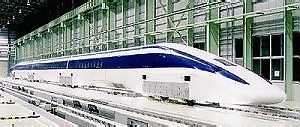
Magnetic-levitation is an application where superconductors perform extremely well. Transport vehicles such as trains can be made to "float" on strong superconducting magnets, virtually eliminating friction between the train and its tracks. Not only would conventional electromagnets waste much of the electrical energy as heat, they would have to be physically much larger than superconducting magnets. A landmark for the commercial use of MAGLEV technology occurred in 1990 when it gained the status of a nationally-funded project in Japan. The Minister of Transport authorized construction of theYamanashi Maglev Test Line which opened on April 3, 1997. In December 2003, the MLX01 test vehicle (shown above) attained an incredible speed of 361 mph (581 kph).
     Although the technology has now been proven, the wider use of MAGLEV vehicles has been constrained by political and environmental concerns (strong magnetic fields can create a bio-hazard). The world's first MAGLEV train to be adopted into commercial service, a shuttle in Birmingham, England, shut down in 1997 after operating for 11 years. A Sino-German maglev is currently operating over a 30-km course at Pudong International Airport in Shanghai, China. The U.S. plans to put its first (non-superconducting) Maglev train into operation on a Virginia college campus. Click this link for a website that listsother uses for MAGLEV.


MRI of a human skull.
     An area where superconductors can perform a life-saving function is in the field of biomagnetism. Doctors need a non-invasive means of determining what's going on inside the human body. By impinging a strong superconductor-derived magnetic field into the body, hydrogen atoms that exist in the body's water and fat molecules are forced to accept energy from the magnetic field. They then release this energy at a frequency that can be detected and displayed graphically by a computer. Magnetic Resonance Imaging (MRI) was actually discovered in the mid 1940's. But, the first MRI exam on a human being was not performed until July 3, 1977. And, it took almost five hours to produce one image! Today's faster computers process the data in much less time. A tutorial is available on MRI at this link. Or read the latest MRI news at this link.
     The Korean Superconductivity Group within KRISS has carried biomagnetic technology a step further with the development of a double-relaxation oscillation SQUID (Superconducting QUantum Interference Device) for use in Magnetoencephalography. SQUID's are capable of sensing a change in a magnetic field over a billion times weaker than the force that moves the needle on a compass (compass: 5e-5T, SQUID: e-14T.). With this technology, the body can be probed to certain depths without the need for the strong magnetic fields associated with MRI's.


      Probably the one event, more than any other, that has been responsible for putting "superconductors" into the American lexicon was the Superconducting Super-Collider project planned for construction in Ellis county, Texas. Though Congress cancelled the multi-billion dollar effort in 1993, the concept of such a large, high-energy collider would never have been viable without superconductors. High-energy particle research hinges on being able to accelerate sub-atomic particles to nearly the speed of light. Superconductor magnets make this possible. CERN, a consortium of several European nations, is doing something similar with its Large Hadron Collider (LHC) recently inaugurated along the Franco-Swiss border.

     Other related web sites worth visiting include the proton-antiproton collider page at Fermilab. This was the first facility to use superconducting magnets. Get information on the electron-proton collider HERA at the German lab pages of DESY (with English text). And Brookhaven National Laboratory features a page dedicated to its RHIC heavy-ion collider.


     Electric generators made with superconducting wire are far more efficient than conventional generators wound with copper wire. In fact, their efficiency is above 99% and their size about half that of conventional generators. These facts make them very lucrative ventures for power utilities. General Electrichas estimated the potential worldwide market for superconducting generators in the next decade at around $20-30 billion dollars. Late in 2002 GE Power Systems received $12.3 million in funding from the U.S. Department of Energy to move high-temperature superconducting generator technology toward full commercialization. To read the latest news on superconducting generators click Here.
     Other commercial power projects in the works that employ superconductor technology include energy storage to enhance power stability. American Superconductor Corp. received an order from Alliant Energy in late March 2000 to install a Distributed Superconducting Magnetic Energy Storage System (D-SMES) in Wisconsin. Just one of these 6 D-SMES units has a power reserve of over 3 million watts, which can be retrieved whenever there is a need to stabilize line voltage during a disturbance in the power grid. AMSC has also installed more than 22 of its D-VAR systems to provide instantaneous reactive power support.

The General Atomics/Intermagnetics General superconducting
Fault Current Controller, employing HTS superconductors.
     Recently, power utilities have also begun to use superconductor-based transformers and "fault limiters". The Swiss-Swedish company ABB was the first to connect a superconducting transformer to a utility power network in March of 1997. ABB also recently announced the development of a 6.4MVA (mega-volt-ampere) fault current limiter - the most powerful in the world. This new generation of HTS superconducting fault limiters is being called upon due to their ability to respond in just thousandths of a second to limit tens of thousands of amperes of current. Advanced Ceramics Limited is another of several companies that makes BSCCO type fault limiters. Intermagnetics General recently completed tests on its largest (15kv class) power-utility-size fault limiter at a Southern California Edison (SCE) substation near Norwalk, California. And, both the US and Japan have plans to replace underground copper power cables with superconducting BSCCO cable-in-conduit cooled with liquid nitrogen. (See photo below.) By doing this, more current can be routed through existing cable tunnels. In one instance 250 pounds of superconducting wire replaced 18,000 pounds of vintage copper wire, making it over 7000% more space-efficient.
     An idealized application for superconductors is to employ them in the transmission of commercial power to cities. However, due to the high cost and impracticality of cooling miles of superconducting wire to cryogenic temperatures, this has only happened with short "test runs". In May of 2001 some 150,000 residents of Copenhagen, Denmark, began receiving their electricity through HTS (high-temperature superconducting) material. That cable was only 30 meters long, but proved adequate for testing purposes. In the summer of 2001 Pirelli completed installation of three 400-foot HTS cables for Detroit Edison at the Frisbie Substation capable of delivering 100 million watts of power. This marked the first time commercial power has been delivered to customers of a US power utility through superconducting wire. Intermagnetics General has announced that its IGC-SuperPower subsidiary has joined with BOC and Sumitomo Electric in a $26 million project to install an underground, HTS power cable in Albany, New York, in Niagara Mohawk Power Corporation's power grid. Sumitomo Electric's DI-BSCCO cable was employed in the first in-grid power cable demonstration project sponsored by the U.S. Department of Energy and New York Energy Research & Development Authority. After connecting to the grid successfully on July 2006, the DI-BSCCO cable has been supplying the power to approximately 70,000 households without any problems. The long-term test will be completed in the 2007-2008 timeframe.


Hypres Superconducting Microchip,
Incorporating 6000 Josephson Junctions.

      The National Science Foundation, along with NASA and DARPA and various universities, are currently researching "petaflop" computers. A petaflop is a thousand-trillion floating point operations per second. Today's fastest computers have reached "petaflop" speeds - quadrillions of operations per second. Currently the fastest is China’s Tianhe-1A, operating at 2.67 petaflops per second. The fastest single processor is a Lenslet optical DSP running at 8 teraflops. It has been conjectured that devices on the order of 50 nanometers in size along with unconventional switching mechanisms, such as the Josephson junctions associated with superconductors, will be necessary to achieve the next level of processing speeds. TRW researchers (now Northrop Grumman) have quantified this further by predicting that 100 billion Josephson junctions on 4000 microprocessors will be necessary to reach 32 petabits per second. These Josephson junctions are incorporated into field-effect transistors which then become part of the logic circuits within the processors. Recently it was demonstrated at the Weizmann Institute in Israel that the tiny magnetic fields that penetrate Type 2 superconductors can be used for storing and retrieving digital information. It is, however, not a foregone conclusion that computers of the future will be built around superconducting devices. Competing technologies, such as quantum (DELTT) transistors, high-density molecule-scale processors , and DNA-based processing also have the potential to achieve petaflop benchmarks.

     In the electronics industry, ultra-high-performance filters are now being built. Since superconducting wire has near zero resistance, even at high frequencies, many more filter stages can be employed to achive a desired frequency response. This translates into an ability to pass desired frequencies and block undesirable frequencies in high-congestion rf (radio frequency) applications such as cellular telephone systems. ISCO International andSuperconductor Technologies are companies currently offering such filters.

      Superconductors have also found widespread applications in the military. HTSC SQUIDS are being used by the U.S. NAVY to detect mines and submarines. And, significantly smaller motors are being built for NAVY ships using superconducting wire and "tape". In mid-July, 2001, American Superconductor unveiled a 5000-horsepower motor made with superconducting wire (below). An even larger 36.5MW HTS ship propulsion motor was delivered to the U.S. Navy in late 2006


      The newest application for HTS wire is in the degaussing of naval vessels. American Superconductor has announced the development of asuperconducting degaussing cable. Degaussing of a ship's hull eliminates residual magnetic fields which might otherwise give away a ship's presence. In addition to reduced power requirements, HTS degaussing cable offers reduced size and weight.

      The military is also looking at using superconductive tape as a means of reducing the length of very low frequency antennas employed on submarines. Normally, the lower the frequency, the longer an antenna must be. However, inserting a coil of wire ahead of the antenna will make it function as if it were much longer. Unfortunately, this loading coil also increases system losses by adding the resistance in the coil's wire. Using superconductive materials can significantly reduce losses in this coil. The Electronic Materials and Devices Research Group at University of Birmingham (UK) is credited with creating the first superconducting microwave antenna. Applications engineers suggest that superconducting carbon nanotubes might be an ideal nano-antenna for high-gigahertz and terahertz frequencies, once a method of achieving zero "on tube" contact resistance is perfected.

      The most ignominious military use of superconductors may come with the deployment of "E-bombs". These are devices that make use of strong, superconductor-derived magnetic fields to create a fast, high-intensity electro-magnetic pulse (EMP) to disable an enemy's electronic equipment. Such a device saw its first use in wartime in March 2003 when US Forces attacked an Iraqi broadcast facility.


A photo of Comet 73P/Schwassmann-Wachmann 3, in the act of disintegrating ,
taken with the European Space Agency S-CAM.
      Among emerging technologies are a stabilizing momentum wheel (gyroscope) for earth-orbiting satellites that employs the "flux-pinning" properties of imperfect superconductors to reduce friction to near zero. Superconducting x-ray detectors and ultra-fast, superconducting light detectors are being developed due to their inherent ability to detect extremely weak amounts of energy. Already Scientists at the European Space Agency (ESA) have developed what's being called the S-Cam, an optical camera of phenomenal sensitivity (see above photo). And, superconductors may even play a role in Internet communications soon. In late February, 2000, Irvine Sensors Corporation received a $1 million contract to research and develop a superconducting digital router for high-speed data communications up to 160 Ghz. Since Internet traffic is increasing exponentially, superconductor technology may be called upon to meet this super need. Irvine Sensors speculates this router may see use in facilitating Internet2.


      According to June 2002 estimates by the Conectus consortium, the worldwide market for superconductor products is projected to grow to near US $38 billion by 2020. Low-temperature superconductors are expected to continue to play a dominant role in well-established fields such as MRI and scientific research, with high-temperature superconductors enabling newer applications. The above ISIS graph gives a rough breakdown of the various markets in which superconductors are expected to make a contribution.

      All of this is, of course, contingent upon a linear growth rate. Should new superconductors with higher transition temperatures be discovered, growth and development in this exciting field could explode virtually overnight.

     Another impetus to the wider use of superconductors is political in nature. The reduction of green-house gas (GHG) emissions has becoming a topical issue due to the Kyoto Protocol which requires the European Union (EU) to reduce its emissions by 8% from 1990 levels by 2012. Physicists in Finland have calculated that the EU could reduce carbon dioxide emissions by up to 53 million tons if high-temperature superconductors were used in power plants.
      The future melding of superconductors into our daily lives will also depend to a great degree on advancements in the field of cryogenic cooling. New, high-efficiency magnetocaloric-effect compounds such as gadolinium-silicon-germanium are expected to enter the marketplace soon. Such materials should make possible compact, refrigeration units to facilitate additional HTS applications. Stay tuned !

Related Posts Plugin for WordPress, Blogger...